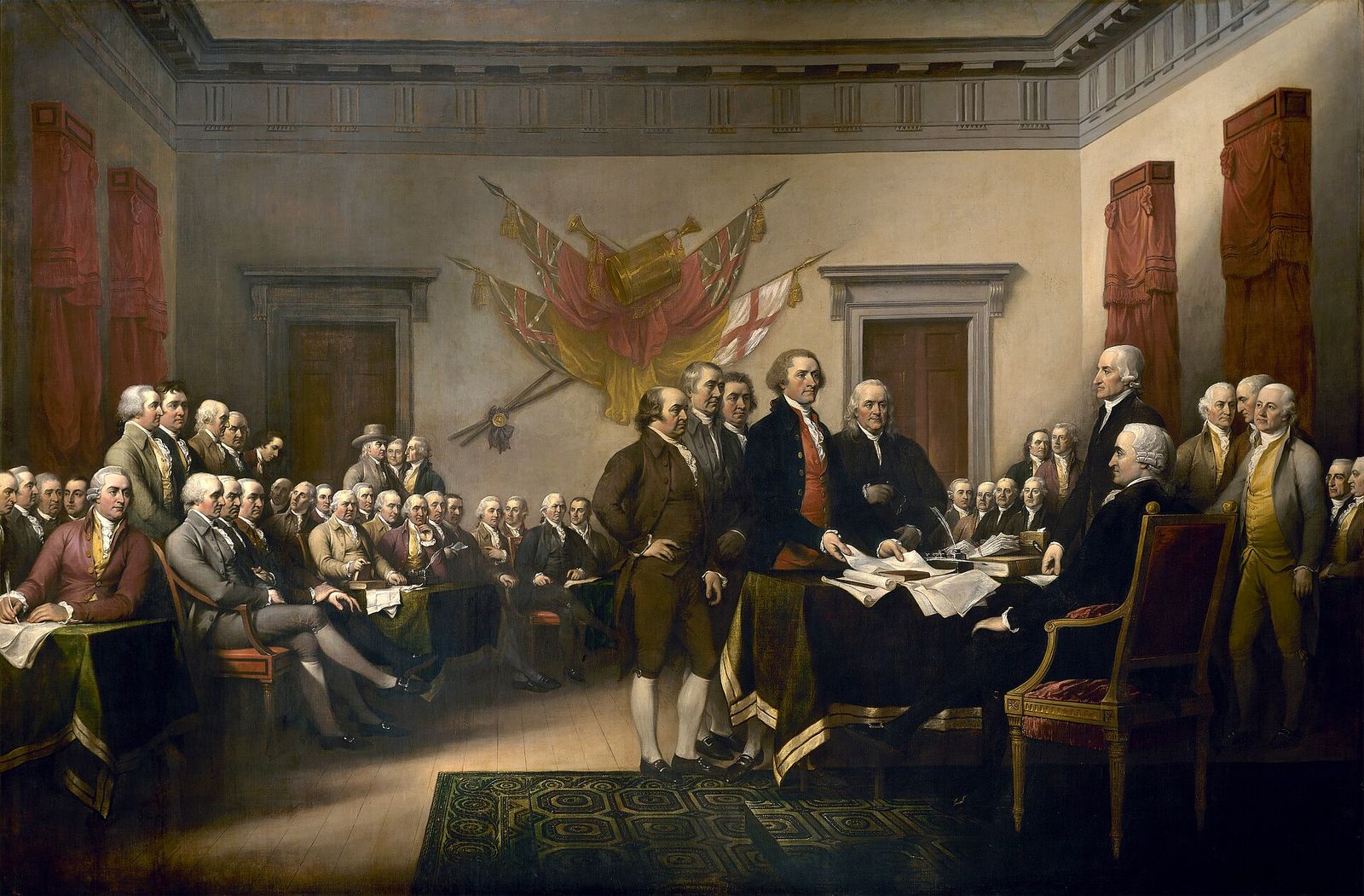
In one minute
- The American Revolution (1765–1783) was a conflict in which 13 British colonies in North America broke away and formed the United States.
- Arguments over taxes and who had the right to make laws for the colonies grew into a war that began in 1775.
- The Declaration of Independence (1776) explained why the colonies were separating, but its promise of equality did not yet include everyone.
- Patriots won with help from France and others. Britain recognized American independence in the Treaty of Paris in 1783.
- Enslaved and free Black people, women, Loyalists and Indigenous nations all made hard choices during the war, and the outcome affected each group differently.
What was the American Revolution?
In the 1700s, Great Britain ruled 13 colonies along the Atlantic coast of North America, stretching from New Hampshire in the north to Georgia in the south. Between about 1765 and 1783, many colonists went from complaining about British laws, to protesting them, to fighting a war to leave the British Empire. That long process is called the American Revolution. It ended with a new country: the United States of America.
A revolution is a big change in who holds power. Historians still argue about how much changed for different people, and that question is one of the most interesting parts of studying it.
How did it start?
An expensive war
From 1754 to 1763, Britain and France fought for control of North America in the French and Indian War. Many Indigenous nations fought too, mostly as allies of the French. Britain won, but the war cost a huge amount of money. British leaders decided the colonies should help pay for their own defense.
Britain also issued the Proclamation of 1763, which told colonists not to settle west of the Appalachian Mountains. Britain hoped this would prevent more wars with Indigenous nations. Many colonists who wanted that land were angry.
Taxes and the right to decide
Parliament, Britain’s law-making body, then passed new taxes on the colonies. The Stamp Act of 1765 taxed printed paper such as newspapers and legal documents. Later, the Townshend Acts taxed imports like glass, paint and tea.
The amount of money was not the main problem for many colonists. The bigger issue was who had the right to decide. Colonists did not elect anyone to Parliament. Many believed only their own colonial assemblies should be able to tax them. This idea is often summed up as “no taxation without representation.”
Colonists answered with boycotts, petitions and protests. Some protests turned violent. In 1770, British soldiers fired into a crowd in Boston and killed five people. In 1773, protesters threw chests of tea into Boston Harbor, an event later called the Boston Tea Party. Parliament punished Massachusetts with strict new laws, and leaders from most colonies met in the First Continental Congress in 1774 to plan a response.
From protest to war
In April 1775, British troops marched from Boston to seize weapons stored in Concord. Local militia met them at Lexington and Concord, and the war began. That summer, the Continental Congress created the Continental Army and chose George Washington of Virginia to lead it.
At first, many colonists hoped to fix things with Britain rather than leave. That changed over the next year. On July 4, 1776, Congress adopted the Declaration of Independence, written mostly by Thomas Jefferson. Its best-known line says:
“We hold these truths to be self-evident, that all men are created equal, that they are endowed by their Creator with certain unalienable Rights, that among these are Life, Liberty and the pursuit of Happiness.”
These words became some of the most important in American history. Yet when they were written, slavery was legal in all 13 colonies, women could not vote in almost every colony, and Indigenous nations were described in the Declaration in insulting terms. Many Americans since then, including people fighting to end slavery and to win voting rights, have used those same words to demand that the promise include them.
The war was long and difficult. The Continental Army lost many battles and often lacked food, clothing and pay. A turning point came in 1777, when Americans won at Saratoga, New York. This victory helped convince France to become an official ally in 1778. French money, soldiers and especially its navy made a huge difference. In 1781, American and French forces trapped a British army at Yorktown, Virginia, and British General Cornwallis surrendered. Fighting slowed after that, and in 1783 the Treaty of Paris recognized the United States as independent.
Who fought, and who was left out?
Patriots and Loyalists
Not every colonist wanted independence. Historians estimate that roughly one in five colonists stayed loyal to Britain. These Loyalists had many reasons: loyalty to the king, fear of war, business ties to Britain, or distrust of Patriot leaders. Many Loyalists lost their homes and property, and tens of thousands left for Canada, Britain or the Caribbean after the war. Families and towns were sometimes split down the middle.
Black Americans, enslaved and free
About one in five people in the colonies was of African descent, and most were enslaved. Black Americans fought on both sides, usually choosing the side that offered the best chance at freedom. In 1775, Virginia’s British governor, Lord Dunmore, promised freedom to enslaved people of Patriot owners who escaped and fought for Britain. Later, British commanders made broader offers. Thousands of people escaped slavery during the war.
Other Black Americans, free and enslaved, served in Patriot militias and the Continental Army. Some won their freedom through service, but many were returned to slavery after the war. Some Northern states began ending slavery during and after the Revolution, while slavery remained and grew in the South.
Women
Women kept farms, shops and households running while men were away. They organized boycotts of British goods and made clothing for soldiers. Some traveled with the army as cooks, nurses and laundresses. A few, like Deborah Sampson, disguised themselves as men to enlist. Women like Abigail Adams wrote about whether the new nation’s freedoms would include them.
Indigenous nations
For Indigenous nations, the main question was how to protect their lands and independence. Many saw that American colonists wanted to move west onto their homelands, so a large number sided with Britain. Others supported the Patriots or tried to stay neutral. The Haudenosaunee (Iroquois) Confederacy split, with most nations siding with Britain and the Oneida and Tuscarora largely supporting the Americans. When the war ended, Britain gave the United States claim to land west of the Appalachians in the treaty, even though Indigenous nations who lived there were not part of the peace talks.
What changed after the war?
The United States was independent, but it still had to build a government. Its first plan, the Articles of Confederation, proved weak. In 1787, leaders wrote the US Constitution, which is still in use today.
For some people, the Revolution brought new freedoms and new ideas about rights. For others, especially enslaved people and Indigenous nations, many hardships continued or got worse. Both stories are true, and good history includes both.
Myths vs. facts
| Myth | Fact |
|---|---|
| All colonists wanted independence. | Colonists were divided. Many were Loyalists, and many others tried to stay out of the conflict. |
| The Declaration of Independence was signed by everyone on July 4, 1776. | Congress adopted it on July 4. Most delegates signed the official copy on August 2, 1776, and some signed later. |
| Americans won the war alone. | Help from France, and later Spain and the Netherlands, was very important, especially France’s navy at Yorktown. |
| The war was only fought by white men. | Black soldiers, Indigenous warriors and women all took part in many ways. |
How to use this page for homework
- Use the timeline to put events in order before writing about causes and effects.
- Pick one group from “Who fought, and who was left out?” and explain how the Revolution affected them. Support your answer with at least two facts.
- When you quote the Declaration of Independence, copy the words exactly and name the source (the National Archives transcription is listed below).
- Check your teacher’s preferred sources. Government archives and national parks are strong places to start.
Timeline
- 1754–1763The French and Indian War (part of the Seven Years' War). Britain wins but ends up deeply in debt.
- 1763Britain's Proclamation of 1763 limits colonial settlement west of the Appalachian Mountains.
- 1765Parliament passes the Stamp Act, taxing printed paper in the colonies. Protests spread and the act is repealed in 1766.
- 1767The Townshend Acts tax imported goods such as glass, paint, paper and tea. Colonists organize boycotts.
- March 5, 1770British soldiers fire into a crowd in Boston, killing five people. Patriots call it the Boston Massacre.
- December 16, 1773Protesters dump 342 chests of tea into Boston Harbor in the Boston Tea Party.
- 1774Parliament passes laws colonists call the Intolerable Acts. The First Continental Congress meets in Philadelphia.
- April 19, 1775Fighting begins at Lexington and Concord in Massachusetts.
- July 4, 1776The Second Continental Congress adopts the Declaration of Independence.
- October 1777The American victory at Saratoga, New York, helps convince France to join the war as an ally.
- 1777–1778Washington's army survives a hard winter at Valley Forge, Pennsylvania.
- October 19, 1781British General Cornwallis surrenders at Yorktown, Virginia, after a siege by American and French forces.
- September 3, 1783The Treaty of Paris is signed. Britain recognizes the independence of the United States.
Key words
- Colony
- A place ruled by a faraway country. The 13 colonies were ruled by Great Britain.
- Parliament
- Great Britain's law-making body. Colonists did not elect any members of it.
- Representation
- Having a person you chose speak and vote for you in government.
- Boycott
- Refusing to buy something as a form of protest.
- Patriot
- A colonist who supported independence from Britain.
- Loyalist
- A colonist who stayed loyal to the British king. Some Loyalists were also called Tories.
- Continental Army
- The army formed by the Continental Congress in 1775 and led by George Washington.
- Declaration of Independence
- The 1776 document that announced the colonies were becoming free and independent states and explained why.
- Militia
- Ordinary citizens trained to fight when needed, rather than full-time soldiers.
- Treaty
- A formal written agreement between nations.
- Ally
- A nation or group that agrees to help another, especially in a war.
Think and write
Printable version- Cause and effect: How did the French and Indian War lead to new taxes on the colonies?
- Explain the phrase "no taxation without representation" in your own words. Do you think it was a fair complaint? Why?
- Read the line from the Declaration of Independence on this page. Who was included in "all men" in 1776? Who was left out?
- Compare a Patriot's point of view with a Loyalist's. List two reasons each might give for their choice.
- Why might an enslaved person choose to join the British side? Why might another choose the Patriot side?
- Many Indigenous nations had to decide which side to support, or whether to stay out of the war. What did they have at stake?
- Pick one event from the timeline. Write three questions a historian might ask about it.
- Was the Revolution a revolution for everyone? Use two facts from this page to support your answer.
Sources and further reading
- Declaration of Independence: A Transcription (opens in a new tab) — National Archives
- Declaration of Independence (1776), Milestone Documents (opens in a new tab) — National Archives
- Treaty of Paris (1783), Milestone Documents (opens in a new tab) — National Archives
- American Revolution (opens in a new tab) — National Park Service
- Minute Man National Historical Park (opens in a new tab) — National Park Service
- Colonial National Historical Park (Yorktown Battlefield) (opens in a new tab) — National Park Service
- Revolutionary War (opens in a new tab) — American Battlefield Trust
- American Revolution (opens in a new tab) — Encyclopaedia BritannicaBot-blocked (403) during automated check on 2026-11-10; page is a long-standing Britannica entry.
Links to outside organizations are for reference. They do not imply that those organizations endorse KidInfo.
Citing this page for school? Use: KidInfo Editorial. “The American Revolution.” KidInfo, updated 2026-11-10. https://kidinfo.com/learn/american-history/american-revolution/