In one minute
- The Industrial Revolution was a change from making things by hand at home to making them with machines in factories.
- In the United States it began with textile mills in New England around 1790 and grew quickly during the 1800s.
- Inventions such as the cotton gin, steam engine, railroad and telegraph changed how people worked, traveled and communicated.
- Factories brought new jobs and products, but also long hours, dangerous work and child labor.
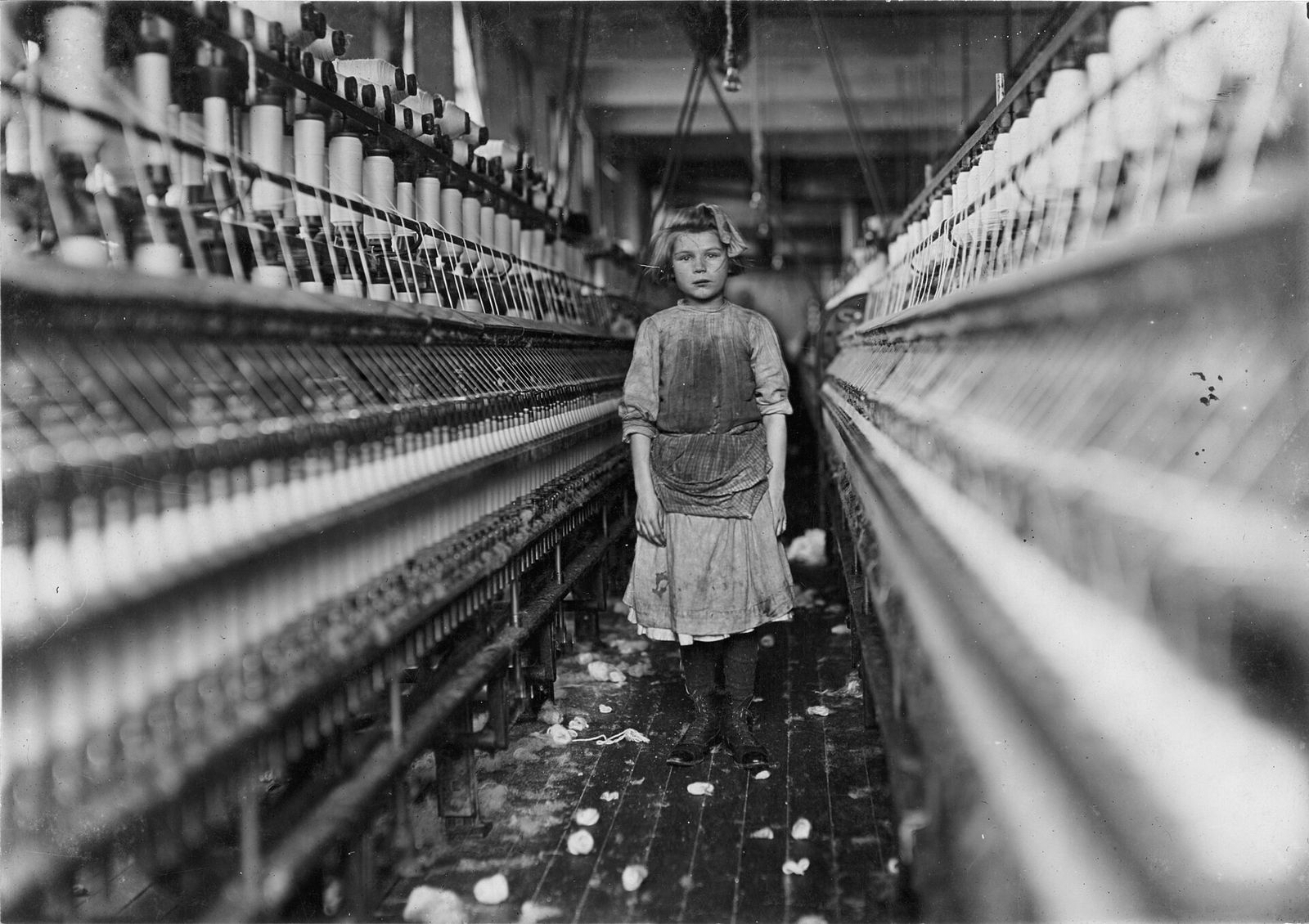
- Workers, reformers and photographers like Lewis Hine pushed for laws that made work safer and limited child labor.
What was the Industrial Revolution?
For most of history, people made almost everything by hand. Families spun thread, wove cloth, made tools and grew their own food. The Industrial Revolution was the period when machines and factories began doing much of that work. It started in Great Britain in the 1700s and spread to the United States after the American Revolution.
The change did not happen in a single year. It unfolded over about a century, from around 1790 to 1900. By the end, the United States had become one of the biggest industrial countries in the world.
The first American factories
Britain tried to keep its textile machine designs secret. Samuel Slater, a young man who had worked in a British cotton mill, memorized how the machines worked and came to America. In 1790 he helped build a water-powered mill in Pawtucket, Rhode Island, that spun cotton into thread. Many people call it the start of the American Industrial Revolution.
Early mills were built beside rivers because they used water power. A river turned a large water wheel, and the wheel turned belts and gears that ran the machines.
The Lowell mill girls
In the 1820s, business owners built a planned factory town in Lowell, Massachusetts. The mills there did every step of making cloth in one place. To run the machines, they hired thousands of young women, mostly from New England farm families.
These “mill girls” lived in company boardinghouses with strict rules. They worked long days, often more than twelve hours, six days a week, in loud, hot rooms filled with cotton dust. Many sent money home to their families. Some wrote for their own magazine, and some organized protests when owners cut pay or added hours. Later, many of the workers in Lowell were immigrants, especially from Ireland.
Inventions that changed everything
The cotton gin
Cleaning seeds out of cotton by hand was slow. In 1794 Eli Whitney received a patent for the cotton gin, a machine that pulled seeds from cotton fibers much faster. Growing cotton became far more profitable.
This had a terrible result. Planters in the South wanted more land and more workers to grow cotton, so slavery grew instead of fading away. The number of enslaved people in the United States rose sharply in the decades after the cotton gin. Northern mills spun the cotton that enslaved people were forced to grow, which tied Northern industry to Southern slavery.
Interchangeable parts
Whitney and other makers promoted the idea of interchangeable parts. If every part was made the same way, a broken piece could be swapped for a new one. This idea helped later factories make guns, clocks, sewing machines and more.
Steam power
Steam engines burned wood or coal to boil water, and the steam pushed parts that made machines move. Factories no longer had to be beside rivers. Steamboats, such as Robert Fulton’s in 1807, could travel upstream against the current, which made river trade faster.
Canals, railroads and the telegraph
The Erie Canal, finished in 1825, connected the Great Lakes to New York City. Soon railroads were being built, and by 1869 a transcontinental railroad linked the East and West coasts. Goods, people and mail traveled faster than ever.
The telegraph sent messages along wires using electric signals. In 1844 Samuel Morse sent a message from Washington, D.C., to Baltimore. News that once took days or weeks could now arrive in minutes.
Cities, immigrants and new jobs
Factories needed workers, and workers needed homes. Cities like New York, Chicago and Pittsburgh grew quickly. Millions of immigrants came from Ireland, Germany, Italy, Poland, China, Eastern Europe and other places to work in factories, mines, railroads and building trades.
Many families lived in crowded tenements with little light or fresh air. Diseases spread easily. At the same time, cities offered schools, libraries, newspapers and new kinds of work.
Child labor
Many children worked in mills, mines, factories and city streets. Some were younger than ten. They worked long hours, often in dangerous places, and many could not go to school. Families sometimes needed the money to survive.
The photographer Lewis Hine traveled the country for the National Child Labor Committee, taking pictures of working children. His photographs showed Americans what these jobs looked like and helped build support for new laws. You can see many of them today at the National Archives and the Library of Congress.
Workers push back
Workers formed labor unions to ask for shorter hours, safer conditions and fair pay. Some strikes were peaceful, and some ended in violence. Reformers, journalists and photographers also pressed for change. States passed their own laws first. In 1938, the Fair Labor Standards Act created a national minimum wage and set limits on child labor across the country.
The Gilded Age
In the late 1800s, industries such as steel, oil and railroads grew enormous. A few business leaders, including Andrew Carnegie and John D. Rockefeller, became extremely rich. The writer Mark Twain helped give this era its nickname, the Gilded Age. Something “gilded” has a thin coat of gold on the outside. The name suggests that the shiny wealth of a few covered up hard lives for many workers and poor city families.
Why it matters
The Industrial Revolution gave Americans more goods, faster travel and new jobs. It also brought dangerous work, child labor and the growth of slavery in the cotton South. Many rules we have today, such as limits on how much children can work, came from people who saw those problems and worked to fix them.
How to use this page for homework
- For a “cause and effect” question, try pairing an invention with what it changed (for example, cotton gin → more cotton → more slavery).
- Use the timeline to show how quickly change happened between 1790 and 1900.
- For a project on child labor, look at Lewis Hine’s photographs through the National Archives link in the sources and describe one image carefully.
- If your class is studying the Gilded Age, start with the last section and then compare it with the early factory years.
Timeline
- 1790Samuel Slater opens a water-powered cotton spinning mill in Pawtucket, Rhode Island.
- 1794Eli Whitney receives a patent for the cotton gin.
- 1807Robert Fulton's steamboat, later called the Clermont, travels up the Hudson River.
- 1825The Erie Canal opens, linking the Great Lakes to New York City by water.
- 1820sTextile mills in Lowell, Massachusetts, begin hiring young women from New England farms.
- 1830Early American railroads begin operating, including the Baltimore and Ohio.
- 1844Samuel Morse sends a telegraph message from Washington, D.C., to Baltimore.
- 1869The first transcontinental railroad is completed at Promontory Summit, Utah.
- 1870s–1890sThe Gilded Age: rapid growth of steel, oil and railroads, huge fortunes, and crowded cities.
- 1904The National Child Labor Committee is formed to fight child labor.
- 1908–1924Lewis Hine photographs working children across the country for the National Child Labor Committee.
- 1938The Fair Labor Standards Act sets a minimum wage and limits child labor nationwide.
Key words
- Industrial Revolution
- A period when machines and factories replaced much hand-made work, changing how people lived and worked.
- Textile
- Cloth, or the threads and fibers used to make cloth.
- Mill
- A building with machines for making something, such as cloth or flour. Early mills used water power.
- Interchangeable parts
- Parts made so alike that any one can replace another, which made manufacturing and repairs faster.
- Telegraph
- A machine that sent messages over wires using electric signals, often in Morse code.
- Immigrant
- A person who moves to a new country to live.
- Child labor
- Children doing work that is harmful, dangerous or keeps them out of school.
- Labor union
- A group of workers who join together to ask for better pay, hours and safety.
- Tenement
- A crowded city apartment building, often with poor light, air and sanitation.
- Gilded Age
- A name for the late 1800s. 'Gilded' means covered with a thin layer of gold, hinting that wealth hid serious problems.
Think and write
Printable version- Explain in your own words what changed during the Industrial Revolution. Use the words 'by hand' and 'by machine.'
- Choose one invention from this page. What problem did it solve, and who did it help or harm?
- Why did the cotton gin lead to more slavery, not less?
- Imagine you are a Lowell mill worker in the 1840s. Write a short letter home describing your day.
- Look at a Lewis Hine photograph from the National Archives. What do you notice? What questions does it raise?
- List two good effects and two harmful effects of factories on American life.
- How did railroads and the telegraph change the speed of travel and news?
Sources and further reading
- Samuel Slater (opens in a new tab) — National Park Service, Blackstone River Valley National Historical Park
- The Mill Girls of Lowell (opens in a new tab) — National Park Service, Lowell National Historical Park
- Patent for Cotton Gin (1794) (opens in a new tab) — National Archives
- Teaching With Documents: Photographs of Lewis Hine: Documentation of Child Labor (opens in a new tab) — National Archives
- Fair Labor Standards Act of 1938: Maximum Struggle for a Minimum Wage (opens in a new tab) — U.S. Department of Labor
- Pacific Railway Act (1862) (opens in a new tab) — National Archives
- Golden Spike National Historical Park (opens in a new tab) — National Park Service
- Industrial Revolution (opens in a new tab) — Encyclopaedia Britannicabot-blocked during automated check (403); page believed to exist.
Links to outside organizations are for reference. They do not imply that those organizations endorse KidInfo.
Citing this page for school? Use: KidInfo Editorial. “The Industrial Revolution in the United States.” KidInfo, updated 2026-11-10. https://kidinfo.com/learn/american-history/industrial-revolution/